
Methods of Crumb Structure Analysis in Bread — Part 3
We are coming to the end in exploring available technics of bread structure analysis. Sharing the next three methods that may surprise you as we're going to look deeeeeep…
While imaging techniques like DIA, micro-CT, and MRI characterize the macro-scale structure of crumb (the gas cell geometry), other methods focus on the microstructure – the composition and fine structure of the cell walls and crumb matrix. This micro-level structure (at the scale of protein and starch networks forming the bubble walls) is also crucial, as it determines crumb resilience and how cells formed and stayed intact.
Confocal Laser Scanning Microscopy (CLSM)
Confocal microscopy is a laser-based optical imaging technique that allows high-resolution observation of fluorescently labeled samples, with the ability to optically "section" through a thick sample. In food science, CLSM has been a powerful tool to visualize multiple components in situ – for example, simultaneously staining proteins, starches, and lipids with different fluorescent dyes to see their arrangement in the food matrix.1 Applied to bread crumb, confocal microscopy can reveal the microscopic morphology of the crumb cell walls. By slicing (or optically sectioning) through a piece of bread, one can observe how starch granules, gelatinised starch gel, and protein (gluten) are distributed around the air cells. Fat droplets or emulsifiers, if present, can also be seen lining pore walls when appropriately stained. Unlike traditional light microscopy, confocal's pinhole optics reject out-of-focus light, yielding a clear image of a specific focal plane inside the sample. By taking a z-stack of optical slices, a partial 3D reconstruction of the crumb's microscopic structure is possible e.g. if we scan large enough stack to combine it into 3D model.
Confocal imaging provides insights into crumb that other structural methods cannot: it differentiates phases (e.g. one can see if protein forms a continuous network or if starch gel surrounds the bubbles uniformly).1 It's especially useful for studying how ingredients or additives alter crumb at the micro-scale – for instance, CLSM has been used to examine how hydrocolloid gums in gluten-free bread affect pore wall morphology, or how enzymes (like anti-staling amylases) modify starch gel structure within the crumb. Researchers have also combined confocal microscopy with image analysis to quantify features like micro-porosity of the cell walls or the thickness of protein strands. Exciting work has been done in Germany, where researches completed CLSM analysis of gluten network during kneading and compared conventional rheometer with Z-blade dough mixer.2 Another study employed double fluorescence staining on a fried bread product's crumb to quantify its porosity and pore size distribution from confocal micrographs, similar to how one would from larger scale images (Figure 1).3 This indicates that CLSM, despite its smaller field of view, can be leveraged for quantitative structural data on a fine scale.
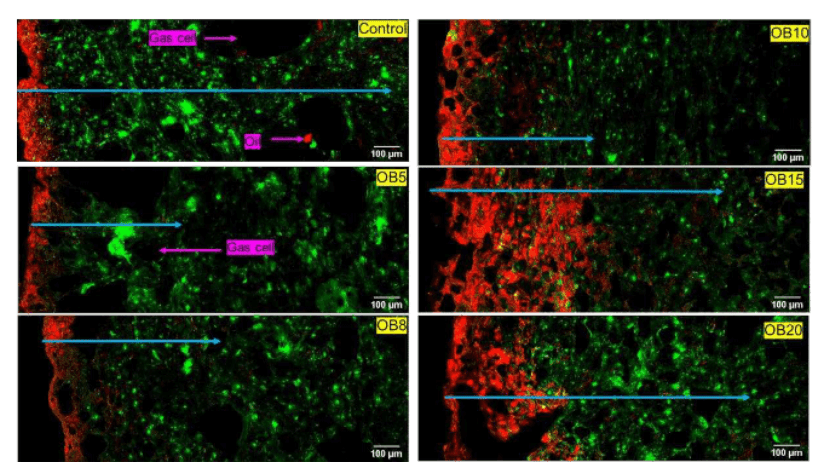
Figure 1. Cross-section micrographs of fried dough enriched with oat bran (OB). Red = oil, green = dough matrix. Blue arrows indicate depth of oil penetration in the solid matrix. OB5–OB20 represent oat bran concentration (g) in product formulation.
Advantages: CLSM can selectively image individual components in a food matrix by using targeted fluorescent probes. This is a big advantage for crumb analysis when you want to know not just the size of a pore, but what the pore wall is made of – e.g. is it a protein-rich film or a starch gel? It yields high-contrast, high-resolution images of soft, wet samples without the need for the dehydration or vacuum required by electron microscopy. Confocal is also versatile: by tuning laser channels and dyes, one can explore different aspects of crumb (protein network integrity, distribution of fat, etc.).
Limitations: The main drawbacks are the need for specialised microscopes and sample preparation involving staining. Bread crumb often needs to be either imaged quickly (before it dries out) or stabilized (some studies embed small crumb samples in resin to cut thin sections for confocal or light microscopy). The field of view is limited (typically a few hundred microns square per image), so it captures only a small portion of the crumb – not fully representative of the whole loaf's structure. Imaging large areas is time-consuming (though stitching multiple fields is possible). Additionally, while confocal can show where components are, it is still essentially a 2D slice at a time (3D stacks are limited in depth by light penetration, maybe a few hundred microns). Thus, confocal is superb for qualitative understanding of crumb microstructure and for targeted measurements, but it's not used for bulk crumb structure metrics like cell size distribution (those are better left to the macro imaging techniques).
Scanning Electron Microscopy (SEM)
Traditional SEM requires careful sample preparation. Pieces of bread crumb are often freeze-dried, fractured to expose internal surfaces, mounted on a conductive tape and sputter-coated with gold to prevent charging during imaging.4 An accelerating voltage of 10–20 kV and magnifications from 50× to 1000× are commonly used.5 Environmental SEM (ESEM) allows imaging under low-vacuum conditions with minimal dehydration. In a 2025 study on oat bran-enriched bread, researchers used a Zeiss EVO LS ESEM to examine crumb structure; specimens were mounted and imaged at 20 kV and 60× magnification, with higher-resolution images captured at 350× and 1000×.5 Another 2024 study investigating sourdough bread coated samples with carbon and observed the crumbs using a JEOL JSM-5400LV SEM at 50× magnification and 5 kV.6 In Arabic bread, fragments of crust and crumb were freeze-dried, fractured and sputter-coated; imaging at 9 kV and magnifications up to 2500× allowed researchers to record micrographs of wheat flour, psyllium husk and bread crumbs.4
The 2025 oat bran study demonstrated the ability of SEM to capture subtle changes in crumb morphology. Environmental SEM images showed that control bread had a continuous sponge-like network, while breads containing undersaturated or oversaturated pre-hydrated oat bran had irregular, coarse crumbs with cracks and large voids. In contrast, bread with optimally saturated bran displayed a honeycomb-like porous structure similar to the control, although bran particles made the surface slightly rougher.5 At higher magnification, gluten proteins in undersaturated bran bread formed a discontinuous matrix around starch granules, which remained oval and partly ungelatinised; oversaturated bran produced composite aggregates where gelatinised starch granules lost their identity.5
A study replacing wheat flour with kiwi starch (10–20%) used SEM to observe dough microstructure. Images of wheat flour showed large A-type starch granules and smaller B-type granules embedded in the gluten network. Kiwi starch exhibited irregular polygonal shapes with smooth surfaces and occasional damage. As the level of kiwi starch increased, SEM micrographs revealed (Figure 2) that the gluten network fractured and pores between networks decreased; at 20% substitution, the network largely collapsed, starch particles were exposed on the surface and pores became small and widely distributed. These structural changes corresponded to denser bread with smaller, more uniform air cells and increased crumb hardness.7
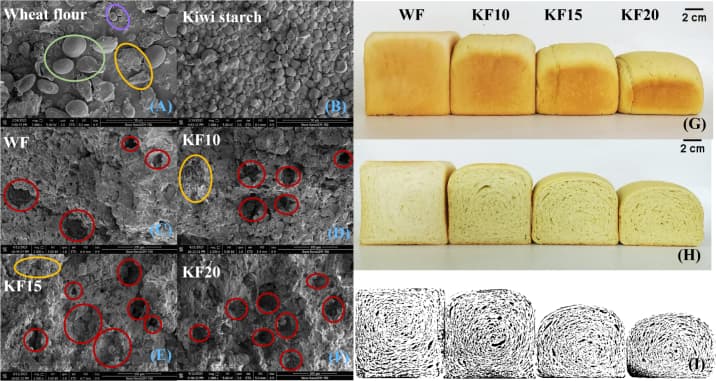
Figure 2. SEM micrograph (×3000) of (A) wheat flour and (B) kiwi starch; (C), (D), (E) and (F) are the SEM micrograph (×1000) of WF, KF10, KF15 and KF20 doughs, respectively; (G), (H), and (I) indicate the appearance and cross-sectional images of WF, KF10, KF15 and KF20, and the bread's cross-sectional images processed by Image J (used to calculate the air cell ratio).
Research on Arabic flat bread enriched with psyllium husk and wheat bran provides further insight into crumb microstructure. SEM images of control white-flour bread showed intact starch granules embedded in a protein matrix, whereas the crumb of wheat-germ flour bread exhibited a continuous gelatinised starch matrix with small holes through which gases and vapours escaped during baking. Increasing psyllium levels caused the gluten network to become denser and more gelatinised; micrographs recorded at 50×–2500× demonstrated that pores were fewer and smaller at higher fibre content. The study also noted that psyllium husk surfaces had rough ridges, which may contribute to higher water-holding capacity.4
SEM has helped to visualise how novel ingredients and fermentation alter gas-cell morphology. Scientists explored the effect of Weissella confusa sourdough on bread structure. SEM images at 50× magnification showed that bread fermented with baker's yeast alone had average gas-cell diameters around 390 µm. Bread made with W. confusa sourdough exhibited much larger gas cells (≈ 605 µm). The authors attributed this to the CO₂-producing capacity of lactic acid bacteria, which resulted in more open crumb structure.6
And not bread but still baking - in a 2023 outreach post from the University of Nottingham's Nanoscale & Microscale Research Centre, shortbread crumbs and surface sugar granules were imaged with a Thermo Fisher Quanta600 SEM. The post highlighted that SEM images expose the intricate microstructure of baked goods and can fascinate both bakers and researchers.8
Advantages: SEM provides ultra-high-resolution images, revealing nanometre-scale details of bread crumb. It excels at examining alveolar wall surfaces, starch granule morphology, gluten strands and the presence of coatings such as fats or emulsifiers. Environmental SEM allows imaging of moist crumbs with reduced dehydration and less sample preparation.5 SEM has been used as definitive proof of phenomena observed by other techniques; for example, it confirms whether additives produce thicker cell walls or whether gluten networks remain intact after fermentation.4
Limitations: However, SEM has several drawbacks. Preparing samples for high vacuum often requires freeze-drying and sputter coating, which may shrink or distort delicate structures; even environmental SEM requires some dehydration. The sample's natural moist, soft state cannot be preserved, so images may not perfectly represent the in-situ crumb. SEM provides only surface views, typically of a fracture face or cut surface, and does not capture three-dimensional connectivity like micro-CT. The method cannot distinguish between chemical components without additional analytical attachments (e.g., energy-dispersive X-ray spectroscopy). Sample preparation and imaging are time-consuming and require specialist equipment, limiting SEM to research rather than routine quality control. Combining SEM with complementary techniques such as confocal laser scanning microscopy, X-ray micro-tomography, MRI or, even, 2D image analysis provides a more complete understanding of bread structure.
References
- Auty MAE. Confocal microscopy: principles and applications to food microstructures. In: Food Microstructures [Internet]. Elsevier; 2013 [cited 2026 Jan 14]. p. 96-P8. Available from: https://linkinghub.elsevier.com/retrieve/pii/B978085709525150004X
- Vidal LM, Ewigmann H, Schuster C, Alpers T, Scherf KA, Jekle M, et al. Microscopic analysis of gluten network development under shear load—combining confocal laser scanning microscopy with rheometry. J Texture Stud. 2023 Dec;54(6):926–35.
- Onipe OO, Beswa D, Jideani AIO. Confocal Laser Scanning Microscopy and Image Analysis for Elucidating Crumb and Crust Microstructure of Bran-Enriched South African Fried Dough. Foods. 2020 May 9;9(5):605.
- Al-Foudari M, Sidhu JS, Alhazza A. Effect of psyllium husk and wheat mill bran fractions on the microstructure and mixograph characteristics of Arabic bread. Saudi J Biol Sci. 2022 Dec;29(12):103479.
- Wu Y, Wang T, De Erive MO, Chen G. Pre-Saturation of Bran as a Strategy for Developing Oat Bran-Enriched Bread. Foods. 2025 June 12;14(12):2071.
- Fhoula I, Dammak I, Nachi I, Smida I, Hassouna M, Ouzari IH. Bread-Making Quality and Reduction of Acrylamide Content Using Weissella confusa Strain V20 from Desert Plant Stipagrostis pungens as Sourdough Additive. Fermentation. 2024 Dec 16;10(12):647.
- She Z, Zhao Q, Hou D, Wang J, Lan T, Sun X, et al. Partial substitution of wheat flour with kiwi starch: Rheology, microstructure changes in dough and the quality properties of bread. Food Chem X. 2024 Oct;23:101614
- Under the microscope [Internet]. Under the microscope. Available from: https://www.nottingham.ac.uk/nmrc/under-the-microscope.aspx